What is a Fard in Real Estate | How to Obtain It and What It Means?

Written By
Admin User
Modified On
March 19, 2026
Reading Time
1 Min Read
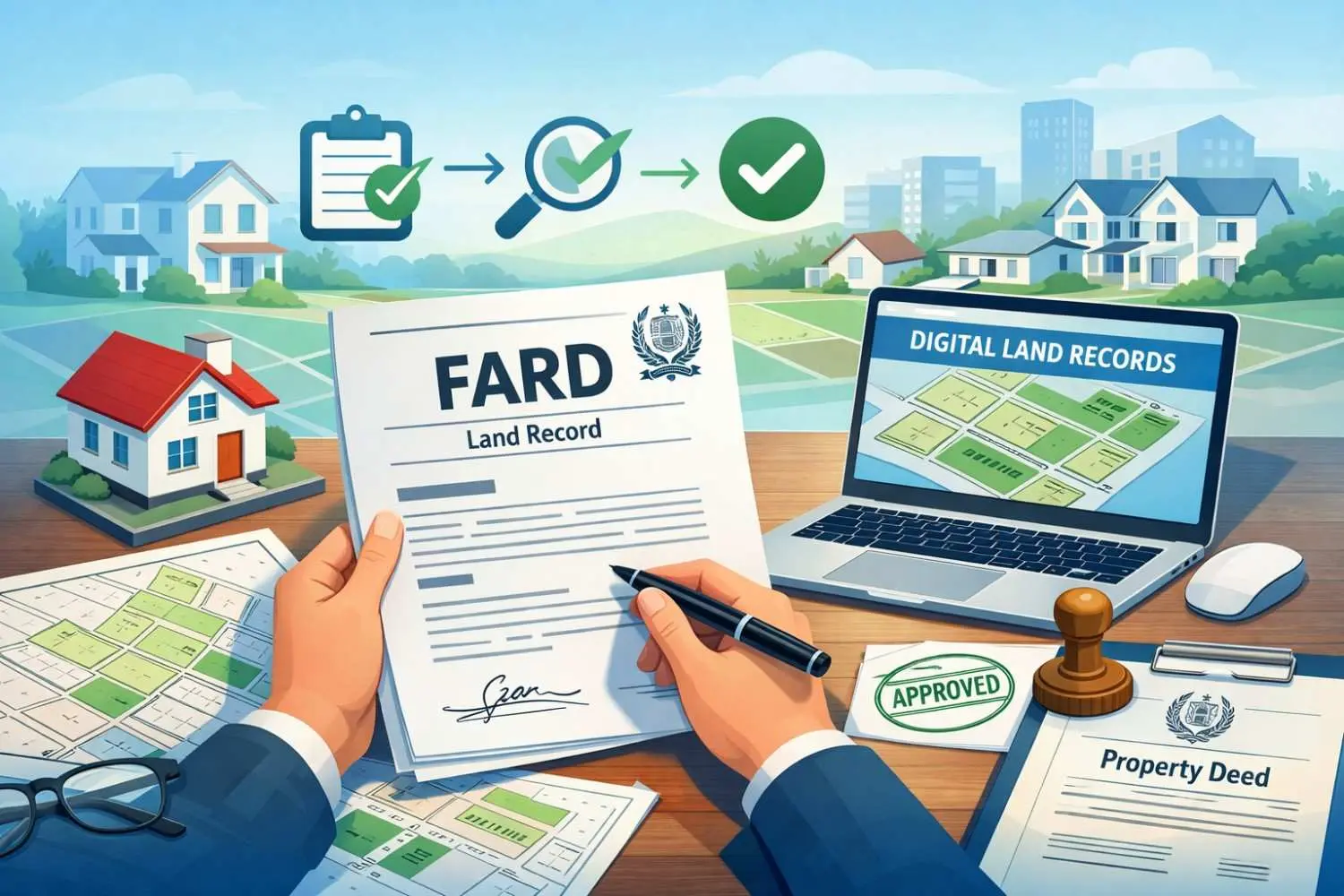
An important land document in India is the fard. Information on the property's history, ownership, and other pertinent details are highlighted in the paper. Keep reading to find out what Fard is, where to get it, and how to use it.
A thorough understanding of the legal paperwork linked to property ownership is crucial for every individual or entity owning property on the planet. Many individuals are confused when they hear the question "What is Fard?" in contrast to more common terminology like "sale deed," "mutation," and "title deed." A fard is a typical form of identification in several parts of India. It goes by several names, including "Jamabandi Nakal" and "Records of Rights (RoR).
An essential part of land records, a Fard provides detailed information on a particular piece of land. Understanding what Fard is is crucial if you are engaged in real estate transactions or simply want to confirm the legitimacy of a property. The document's essential details are presented below.
About Fards
An official replica of a particular parcel of land's Record of Rights (RoR) is known as a Fard. The state government's land records department is responsible for maintaining the document. One better way to describe it is as a thorough property ledger entry. The present and past owners of a property are detailed in this document, as is its history. The Fard is an assemblage of records pertaining to the cultivation, ownership, and other pertinent data of a piece of land, rather than a singular document. In the realms of land management and real estate transactions, this instrument is indispensable.
What Details Are Contained in Fard?
Important information for real estate due diligence can be found in a Fard document. Important information included in a Fard includes-
Owner Information: The name and address of the present legal owner of the land, as well as their father's name, shall be clearly stated on a Fard document. Additionally, if there are any co owners, their respective shares are detailed.
The type of land is specified by a Fard. It specifies if the piece of land is irrigated or not, if it is residential or commercial, and if it is agricultural or not.
Land data such as the Khasra and Khatoni numbers, area in different units, and boundaries are detailed in the document that serves as a property description.
Specifics of Cultivation: This pertains to property that is used for farming. The type of soil and the crops that were grown may be detailed in it.
The details of the revenue that is due to the government from that particular parcel of property will be included in it.
The section about encumbrance is crucial. If there are any mortgages, liens, or other claims against the property, a Fard will show them. This may encompass monetary commitments associated with the property, such as loans from financial institutions or court decrees.
How the present owner came to own the property (via sale, bequest, inheritance, etc.) is also detailed in the document.
Mutation Records: It shows how ownership has changed throughout time. Any one of the following: sale, bequest, gift, or partition could be the cause. The transfer of ownership of any given piece of property always results in what is known as a "mutation." It is in the Fard that these changes are documented.
How Comes Fard Matter?
An essential document for keeping track of land in India is the fard. The reasons why it is vital are as follows:
- It is the main piece of proof of ownership in a legal sense.
- You can use it to see if the seller has a clear title, if there are any issues, and if the property is unencumbered.
- Home loans and loans secured by property are not sanctioned by banks without a Fard.
- In the event of a border dispute or other land dispute, a fard is an essential legal document.
- If farmers want to take advantage of government programs like crop insurance or subsidies, they need the Fard.
- Any time the land's status changes, it's updated accordingly. This guarantees that the government's land records are kept accurate.
What Information and Paperwork Are Necessary for a Fard?
Fard (Jamabandi Nakal) applications have been considerably simplified in a number of states. You may get Fard services online in a lot of states right now. If you want to buy Fard online, you'll need these things:
How to Meet Fard's Standards
In order to get a Fard document, you need the following:
- Locating Land: The unique survey number, Khasra number, or Khewat/Khatauni number of the plot of land is required.
- The name of the hamlet, tehsil, and district are examples of precise geological details that you must include.
- Identity documents and proof of your connection to the property owner or potential buyer are required pieces of information for the application.
- Additional Documents Necessary for Fard
- Physical applications may still be necessary, even though the process is moving online more and more:
- Application forms can be obtained either online or at the Patwari/Tehsil office.
- Documentation of Identity (PAN Card, Aadhar Card, Passport, Voter ID).
- Evidence of Residence.
- Affidavit (if necessary for specific purposes).
- If you are the owner, you must provide proof of ownership, such as a mutation certificate or a copy of the previous sale transaction.
- The documentation of any fees that have been paid.
Can You Tell Me How Much a Fard Will Cost?
Getting a Fard usually doesn't cost much. The price could change depending on where you live and even the kind of copy you need. Prices usually fall between 10 and 50 rupees. Online portals typically provide the precise fee. Such an important legal document is well worth the little charge.
Conclusion
Among India's most revered land records is the Fard. It draws attention to important details of a piece of land. It specifies who owns what, what the property is like, and whether there are any liens on it. Any party to a property purchase must fully understand and confirm that the Fard is non-negotiable. In the event of a disagreement or false claim, the paper guarantees openness and protection.
Admin User
Author

Recent Post

Real Estate Referral Income: A Complete Guide...
March 19, 2026
How to Earn Money Without Investment in 2026: A Complete Guide for Beginners
March 19, 2026
A Beginner's Guide to Making Money Online in India
March 19, 2026
What is Referral Income? Full Guide to make referral income in India
March 19, 2026
Commercial Real Estate Segmentation in Delhi-NCR: From Demographics to Psychographics
March 19, 2026
A Road Network Map of Uttar Pradesh Featuring Fifteen or Motorways
March 19, 2026
Average Cost of Residential Construction in India
March 19, 2026